Auratus cichlid
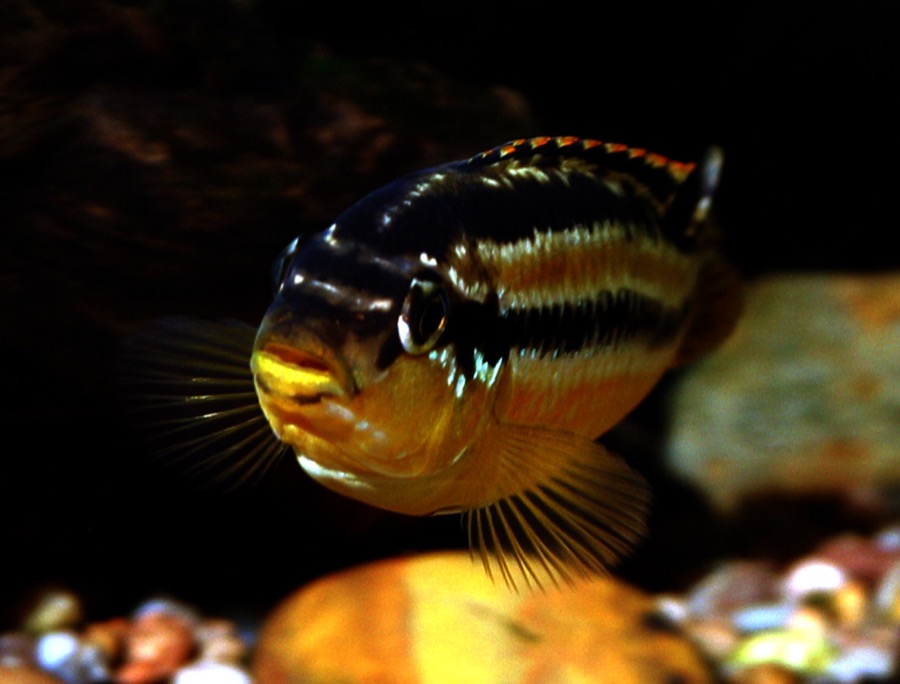
Sold on the strength of a female's yellow-and-black stripes, which is the wrong fish to judge it by: males turn dark and become among the most persistently aggressive animals in the freshwater trade. It is a competent, hardy cichlid kept in the wrong tank almost every time.
Quick profile
- Scientific name
- Melanochromis auratus
- Adult size
- 10–13 cm (3.9–5.1 in)
- Lifespan
- 5–8 years
- Temperature
- 24–28 °C (75–82 °F)
- pH
- 7.5–8.8
- Hardness
- 10–25 °dGH
- Minimum tank
- 200 L (53 US gal)
- Minimum length
- 120 cm
- Swimming zone
- All levels
- Social
- Harem
- Diet
- Herbivore
- Overall confidence
- moderate confidence
What keeping this species involves
Undemanding about water and food, and demanding about everything else: tank length, rock structure, sex ratio and a keeper willing to remove a fish that will not stop.
Rocky and intermediate shoreline zones grazing algae from rock surfaces.
Identity and names
- Common name
- Auratus cichlid
- Scientific name
- Melanochromis auratus
- Family
- Cichlidae
- Order
- Cichliformes
- Class
- Actinopterygii
- Also sold as
- golden mbuna, Malawi golden cichlid, Melanochromis auratus
Adult size and growth
10–13 cm (3.9–5.1 in)
Typical lifespan in an aquarium: 5–8 years. Almost every animal sold in a shop is a juvenile, so the tank has to suit the size in the first line rather than the size in the bag.
Shape, which is what the compatibility engine reads instead of length alone: deep-bodied with a moderate. Assigned from what is typical of Cichlidae, not examined for this species.
Water and tank requirements
A male's territory is large and he pursues across the whole tank; length and rock structure to break sightlines are what make the aggression survivable rather than fatal.
Temperature (°C)
Scale: 0 to 36 °C.
pH (pH)
Scale: 4 to 9.5 pH.
Hardness (°dGH)
Scale: 0 to 30 °dGH.
Where these figures come from
Habitat class
Lake Malawi
A large rift lake — alkaline and well buffered, but considerably softer and less mineral-rich than Tanganyika.
Alkaline but not hard. The widespread advice to add large quantities of salt mix for Malawi cichlids overshoots the lake, and the pH matters more than the hardness does.
- Conductivity
- 200–280 µS/cm
- Flow
- low
- Dissolved oxygen
- near saturation
- Seasonality
- weak
These are figures for the KIND of water body, not measurements of this species. They are AquariumHQ’s summary of the general limnology and are given wide because the water is.
- TemperatureFollows the habitat this animal comes from
- Follows the water this animal is recorded from — lake malawi. Lake Malawi generally runs 23–28°C, and the advised band of 24–28°C is consistent with it. This is AquariumHQ's reasoning from the habitat, not a measurement of the species.
- pHFollows the habitat this animal comes from
- Follows the water this animal is recorded from — lake malawi. Lake Malawi generally runs 7.7–8.6, and the advised band of 7.5–8.8 is consistent with it. This is AquariumHQ's reasoning from the habitat, not a measurement of the species.
- General hardnessFollows the habitat this animal comes from
- Follows the water this animal is recorded from — lake malawi. Lake Malawi generally runs 5–11 dGH, and the advised band of 10–25 dGH is consistent with it. This is AquariumHQ's reasoning from the habitat, not a measurement of the species.
Scale: 22.3 to 28.8 °C.
Scale: 7.3 to 9 pH.
Scale: 2 to 28 dGH.
| Requirement | Value | Notes |
|---|---|---|
| Temperature | 24–28 °C (75–82 °F) | Stability matters more than hitting an exact figure. |
| pH | 7.5–8.8 | A stable pH outside the ideal band is usually better than an unstable one inside it. |
| General hardness | 10–25 °dGH | Check your supplier's published figure before choosing species. |
| Carbonate hardness | 8–18 °dKH | Buffering capacity — what stops the pH moving. |
| Minimum volume | 200 L (53 US gal) | A floor, not a recommendation. |
| Minimum footprint | 120 cm long | A male's territory is large and he pursues across the whole tank; length and rock structure to break sightlines are what make the aggression survivable rather than fatal. |
| Water flow | moderate | Match the outflow to this rather than to the filter's rating. |
| Lid required | Recommended | Reduces evaporation and prevents accidents. |
| Structure | Heavy rockwork built to the surface, dividing the tank into visually separate areas. Open water offers a pursued fish nowhere to go. |
Behaviour
- Grazes rock surfaces continuously and patrols a territory between feeding.
- A dominant male pursues subordinates to exhaustion where there is nowhere to break away to.
Telling males from females
Females and juveniles are yellow with two black stripes. Mature males invert to dark brown-black with pale stripes, which is why buyers routinely take home the wrong sex.
Feeding
An algae grazer with a long gut. Regular high-protein feeding is associated with the intestinal disorder aquarists call Malawi bloat.
- Diet type
- Herbivore
- Staples
- Vegetable-based dry foods, Spirulina, Blanched vegetables
- Avoid
- Bloodworm, High-protein foods fed regularly
Breeding
- Strategy
- Maternal mouthbrooding
- Difficulty
- incidental
- Parental care
- mouthbrooding
Females hold eggs and fry in the mouth for roughly three weeks and do not feed while holding.
Tankmates and compatibility
Assessments are derived from stored traits by the compatibility engine, with the reasoning shown. A verdict is a statement about probability, not a guarantee — individual temperament can override it.
| Towards | Risk | What it means |
|---|---|---|
| Small fish | high | Anything that fits in the mouth is at risk once this species reaches adult size. |
| Adult dwarf shrimp | near-certain | Cover reduces losses but rarely prevents them where the risk is high. |
| Shrimplets | near-certain | Determines whether a shrimp colony can grow rather than merely persist. |
| Snails | moderate | Applies to snails you wanted as well as snails you did not. |
| Long or trailing fins | frequent | Fin damage is an entry point for secondary infection. |
| Plants | consumes | Tough species such as Anubias and Java fern survive most grazers. |
Any pair in the catalogue can be assessed with the compatibility checker.
Welfare considerations
Points where the way this species is commonly sold or kept differs from what it actually needs.
- Aggression here is not a temperament that settles. A tank without enough length and structure produces deaths rather than squabbles.
- Frequently sold as a beginner's African cichlid on colour. The colourful fish in the shop tank is usually a female or an immature male.
- Not a community fish under any stocking that also contains a small or long-finned species.
Problems to watch for
Most problems in a tank containing this species are general rather than species-specific. Start with the troubleshooting index and work from the observation rather than from a guess at the cause.
What AquariumHQ does not yet hold
Species-level disease susceptibility is modelled in the graph and is not yet populated. Health pages will not be published until each condition has veterinary sourcing, because health content written without evidence is the most harmful thing this product could publish. The gap is recorded in the coverage report.
Where it comes from
- Native range
- Lake Malawi — south-western shores and offshore islands
- Habitat
- Rocky and intermediate shoreline zones grazing algae from rock surfaces.
What the checklists say
7 distribution statements retrieved from GBIF checklists. Establishment means is reproduced from the source where it states one, and left unstated where it does not — a record of presence is not a record of origin.
| Status | Places | What this means |
|---|---|---|
| Introduced | 4 | A checklist states the species arrived here with human help. That is not a statement that it is established, harmful or illegal. |
| Recorded as present, establishment means not stated | 3 | The source records the species as present and does not say whether it is native or introduced. AquariumHQ does not fill that in. |
No checklist AquariumHQ holds positively calls this species native anywhere, so the native range above rests on AquariumHQ’s own reading of the literature rather than on a cited checklist.
Evidence
Every stored value with the kind of support behind it and where to check it. Evidence type and confidence are separate axes: an editorial position held confidently and a measurement held tentatively are different things.
| Claim | Value | Evidence type | Confidence | Source |
|---|---|---|---|---|
| scientific name | Melanochromis auratus | Observed / measured | high confidence | Catalogue of Life; GBIF — Global Biodiversity Information Facility |
| native range | Lake Malawi — south-western shores and offshore islands | Observed / measured | moderate confidence | GBIF — Global Biodiversity Information Facility |
| adult size | 10–13 cm | Aquarium-literature consensus | moderate confidence | AquariumHQ husbandry synthesis |
| lifespan | 5–8 years | Aquarium-literature consensus | moderate confidence | AquariumHQ husbandry synthesis |
| temperature | 24–28 °C | Aquarium-literature consensus | moderate confidence | AquariumHQ husbandry synthesis |
| ph | 7.5–8.8 pH | Aquarium-literature consensus | moderate confidence | AquariumHQ husbandry synthesis |
| general hardness | 10–25 °dGH | Aquarium-literature consensus | moderate confidence | AquariumHQ husbandry synthesis |
| minimum tank volume | ≥ 200 L | AquariumHQ editorial position | moderate confidence | AquariumHQ husbandry synthesis |
| minimum tank length | ≥ 120 cm | AquariumHQ editorial position | moderate confidence | AquariumHQ husbandry synthesis |
| carbonate hardness | 8–18 °dKH | Aquarium-literature consensus | moderate confidence | AquariumHQ husbandry synthesis |
Last reviewed 2026-08-10. Values labelled as an aquarium-literature consensus are AquariumHQ editorial positions rather than measurements — see how evidence is handled.
Why we say this
What each figure on this page rests on, and how far that is from being independently established.
Every figure on this page has a provenance. Open any claim to see what AquariumHQ holds for it, which sources say what, and what a claim of that kind actually needs. Different claims need different evidence: an accepted scientific name is settled by one authority, while a legal restriction needs a current primary instrument. A single source is often the right answer rather than a thin one.
scientific nameAquariumHQ's own position, externally checkableBased on a verified authoritative source.
AquariumHQ's own position on a claim an external source could support.
What this kind of claim needs: accepted scientific name and classification — 1 authoritative source in an appropriate context. Checked against gbif on 2026-08-12. One authoritative backbone is what this class requires.
What would improve this: Go and read a source. This is reachable and has not been reached.
native rangeAquariumHQ's own position, externally checkableBased on a verified authoritative source.
AquariumHQ's own position on a claim an external source could support.
What this kind of claim needs: where the species occurs — 1 authoritative source in an appropriate context. 7 distribution statements held from GBIF checklists — introduced in 4 country. Establishment means is reproduced from the source, never inferred from occurrence.
What would improve this: Go and read a source. This is reachable and has not been reached.
adult sizeAquariumHQ's own position, externally checkableAquariumHQ's own position, derived from evidenced inputs.
AquariumHQ's own position on a claim an external source could support.
What this kind of claim needs: size a well-kept specimen reaches — no external source is required, provided AquariumHQ shows its reasoning. No external source is required for this class. AquariumHQ's position stands on its stated reasoning.
What would improve this: Go and read a source. This is reachable and has not been reached.
lifespanAquariumHQ's own position, externally checkableAquariumHQ's own position, derived from evidenced inputs.
AquariumHQ's own position on a claim an external source could support.
What this kind of claim needs: what aquariumhq advises for keeping — no external source is required, provided AquariumHQ shows its reasoning. No external source is required for this class. AquariumHQ's position stands on its stated reasoning.
What would improve this: Go and read a source. This is reachable and has not been reached.
temperatureAquariumHQ's own position, externally checkableAquariumHQ's own position, derived from evidenced inputs.
AquariumHQ's own position on a claim an external source could support.
What this kind of claim needs: what aquariumhq advises for keeping — no external source is required, provided AquariumHQ shows its reasoning. No external source is required for this class. AquariumHQ's position stands on its stated reasoning.
What would improve this: Go and read a source. This is reachable and has not been reached.
phAquariumHQ's own position, externally checkableAquariumHQ's own position, derived from evidenced inputs.
AquariumHQ's own position on a claim an external source could support.
What this kind of claim needs: what aquariumhq advises for keeping — no external source is required, provided AquariumHQ shows its reasoning. No external source is required for this class. AquariumHQ's position stands on its stated reasoning.
What would improve this: Go and read a source. This is reachable and has not been reached.
general hardnessAquariumHQ's own position, externally checkableAquariumHQ's own position, derived from evidenced inputs.
AquariumHQ's own position on a claim an external source could support.
What this kind of claim needs: what aquariumhq advises for keeping — no external source is required, provided AquariumHQ shows its reasoning. No external source is required for this class. AquariumHQ's position stands on its stated reasoning.
What would improve this: Go and read a source. This is reachable and has not been reached.
minimum tank volumeAquariumHQ's judgement — no authority publishes thisAquariumHQ's own position, derived from evidenced inputs.
No external authority publishes this. The rationale carries the reasoning.
What this kind of claim needs: minimum tank size — no external source is required, provided AquariumHQ shows its reasoning. No authority publishes this. AquariumHQ derives it, and the derivation is recorded with its inputs and assumptions.
What would improve this: Keep the rationale current. There is no source to find.
minimum tank lengthAquariumHQ's judgement — no authority publishes thisAquariumHQ's own position, derived from evidenced inputs.
No external authority publishes this. The rationale carries the reasoning.
What this kind of claim needs: minimum tank size — no external source is required, provided AquariumHQ shows its reasoning. No authority publishes this. AquariumHQ derives it, and the derivation is recorded with its inputs and assumptions.
What would improve this: Keep the rationale current. There is no source to find.
carbonate hardnessAquariumHQ's own position, externally checkableAquariumHQ's own position, derived from evidenced inputs.
AquariumHQ's own position on a claim an external source could support.
What this kind of claim needs: what aquariumhq advises for keeping — no external source is required, provided AquariumHQ shows its reasoning. No external source is required for this class. AquariumHQ's position stands on its stated reasoning.
What would improve this: Go and read a source. This is reachable and has not been reached.
Guides relevant to this species
Chosen from this record's own traits rather than listed on every page.
- Predator and prey sizeIt takes fish that fit in its mouth, and its mouth grows with it.
- Territorial behaviourIt defends ground, and the shape of what it defends decides the tank more than the volume does.
- The kinds of water aquarium fish come fromThis record's water bands follow lake malawi, which is the kind of water this animal is recorded from.
- How to read a compatibility verdictThis animal is recorded as nipping fins, which is one of the few compatibility factors with real reports behind it.
Group size and social behaviour
A male holds a territory and pursues everything in it. Numbers are used to spread aggression rather than to make a peaceful group.