White-blotched river stingray
A black freshwater stingray covered in white spots, endemic to the Rio Xingu, reaching a disc close to a metre across and carrying a venomous barb capable of causing serious injury. It is a specialist animal on every axis — space, water quality, diet, handling and law.
Quick profile
- Scientific name
- Potamotrygon leopoldi
- Adult size
- 60–90 cm (23.6–35.4 in)
- Lifespan
- 15–25 years
- Temperature
- 26–30 °C (79–86 °F)
- pH
- 6–7.2
- Hardness
- 1–8 °dGH
- Minimum tank
- 4000 L (1057 US gal)
- Minimum length
- 400 cm
- Swimming zone
- Bottom
- Social
- Loose group — at least 2
- Diet
- Carnivore
- Overall confidence
- moderate confidence
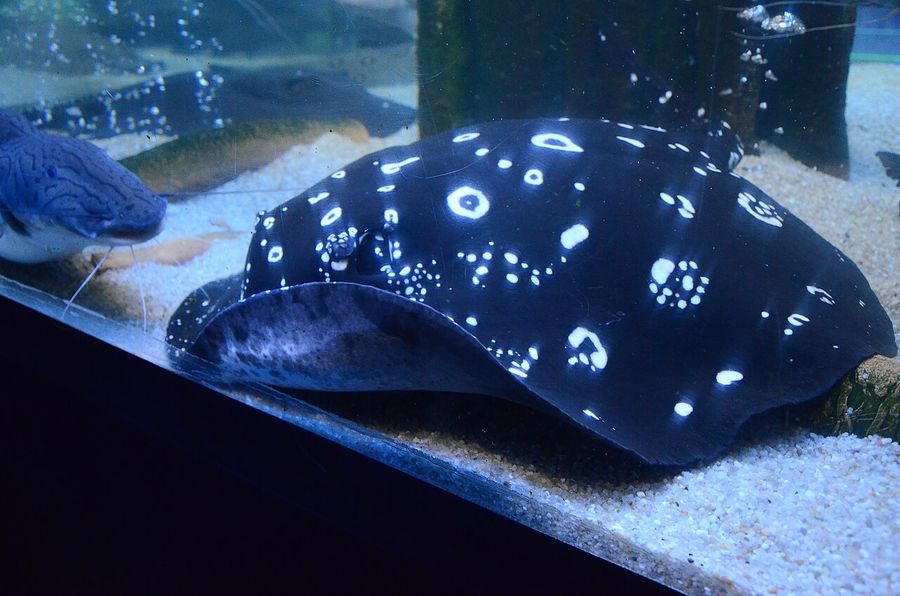
What keeping this species involves
A metre-wide animal with no tolerance for poor water, a venomous defence, a twenty-year life and legal restrictions in many jurisdictions. Every one of those is disqualifying on its own for most keepers.
Sandy floors of a warm clearwater river, in soft water with strong flow over the rapids and quieter sand between them.
Identity and names
- Common name
- White-blotched river stingray
- Scientific name
- Potamotrygon leopoldi
- Family
- Potamotrygonidae
- Order
- Myliobatiformes
- Class
- Chondrichthyes
- Also sold as
- Potamotrygon leopoldi, Xingu ray, polka dot stingray, black diamond stingray
Adult size and growth
60–90 cm (23.6–35.4 in) — Disc width rather than total length. The tail adds substantially and the tank has to accommodate the whole animal turning.
Typical lifespan in an aquarium: 15–25 years. Almost every animal sold in a shop is a juvenile, so the tank has to suit the size in the first line rather than the size in the bag.
Shape, which is what the compatibility engine reads instead of length alone: depressed — flattened top to bottom with a large — a piscivore's mouth. A benthic predator that engulfs prey from above. Length ratios do not describe it at all and the shape model is a poor fit; the predation traits carry the assessment.
Water and tank requirements
A ray with a disc approaching a metre needs floor area on both axes rather than length alone — it must be able to turn without folding. Width is as much a constraint as length, which is true of almost nothing else in this catalogue.
Temperature (°C)
Scale: 0 to 36 °C.
pH (pH)
Scale: 4 to 9.5 pH.
Hardness (°dGH)
Scale: 0 to 30 °dGH.
Why these ranges: Xingu clearwater is warm, soft and near-neutral. Freshwater rays have almost no tolerance for accumulated nitrogenous waste and are among the most water-quality-sensitive animals in the freshwater hobby, which makes the maintenance regime more consequential than the chemistry.
Where these figures come from
Habitat class
Clearwater lowland river — the Rio Xingu
Transparent, mineral-poor rivers draining ancient shield geology — the Tapajós and Xingu type — with low sediment and good light penetration.
Soft water with more movement and more oxygen than a forest stream. Species from here generally want current and open swimming room as much as they want the chemistry.
- Conductivity
- 20–100 µS/cm
- Flow
- moderate
- Dissolved oxygen
- near saturation
- Seasonality
- strong
These are figures for the KIND of water body, not measurements of this species. They are AquariumHQ’s summary of the general limnology and are given wide because the water is.
- TemperatureReasoned on this record
- This record states its own reason for this band. See the water section.
- pHReasoned on this record
- This record states its own reason for this band. See the water section.
- General hardnessReasoned on this record
- This record states its own reason for this band. See the water section.
| Requirement | Value | Notes |
|---|---|---|
| Temperature | 26–30 °C (79–86 °F) | Stability matters more than hitting an exact figure. |
| pH | 6–7.2 | A stable pH outside the ideal band is usually better than an unstable one inside it. |
| General hardness | 1–8 °dGH | Check your supplier's published figure before choosing species. |
| Minimum volume | 4000 L (1057 US gal) | A floor, not a recommendation. |
| Minimum footprint | 400 cm long × 200 cm deep | A ray with a disc approaching a metre needs floor area on both axes rather than length alone — it must be able to turn without folding. Width is as much a constraint as length, which is true of almost nothing else in this catalogue. |
| Water flow | moderate | Match the outflow to this rather than to the filter's rating. |
| Lid required | Recommended | Reduces evaporation and prevents accidents. |
| Structure | A large area of fine soft sand and nothing sharp. Rays abrade their discs on rough surfaces and the injuries are slow to heal. |
Behaviour
- Buries in sand with only the eyes and spiracles exposed and detects buried prey by electroreception.
- Rests flat on the substrate for long periods and glides rather than swims, using undulations of the disc margin.
Telling males from females
Males have paired claspers at the base of the pelvic fins. The difference is unambiguous once the animal is mature.
Feeding
Takes crustaceans, molluscs and fish, located by electroreception and by touch. It feeds heavily and produces waste accordingly, which is the main driver of the maintenance requirement.
- Diet type
- Carnivore
- Staples
- Prawn, Mussel, Whole frozen fish, Earthworm
- Avoid
- Mammalian meat, Dry pellets
Breeding
- Strategy
- Live birth of a small number of fully formed young after a gestation of several months
- Difficulty
- challenging
- Parental care
- bearer
Bred in captivity by specialists. Females can be injured by males during courtship, which is a real husbandry consideration rather than an incidental one.
Tankmates and compatibility
Assessments are derived from stored traits by the compatibility engine, with the reasoning shown. A verdict is a statement about probability, not a guarantee — individual temperament can override it.
| Towards | Risk | What it means |
|---|---|---|
| Small fish | near-certain | Anything that fits in the mouth is at risk once this species reaches adult size. |
| Adult dwarf shrimp | near-certain | Cover reduces losses but rarely prevents them where the risk is high. |
| Shrimplets | near-certain | Determines whether a shrimp colony can grow rather than merely persist. |
| Snails | near-certain | Applies to snails you wanted as well as snails you did not. |
| Long or trailing fins | none | Fin damage is an entry point for secondary infection. |
| Plants | uproots | Tough species such as Anubias and Java fern survive most grazers. |
Any pair in the catalogue can be assessed with the compatibility checker.
Welfare considerations
Points where the way this species is commonly sold or kept differs from what it actually needs.
- The tail barb carries venom and a sting causes severe pain and tissue damage. Never work in the tank with bare hands, never lift a ray in a net, and treat any sting as a medical emergency.
- Extremely intolerant of nitrogenous waste. Rays are usually lost to water quality rather than to disease, and the maintenance regime is the husbandry.
Problems to watch for
Most problems in a tank containing this species are general rather than species-specific. Start with the troubleshooting index and work from the observation rather than from a guess at the cause.
What AquariumHQ does not yet hold
Species-level disease susceptibility is modelled in the graph and is not yet populated. Health pages will not be published until each condition has veterinary sourcing, because health content written without evidence is the most harmful thing this product could publish. The gap is recorded in the coverage report.
Where it comes from
- Native range
- Brazil — the Rio Xingu and its tributaries
- Habitat
- Sandy floors of a warm clearwater river, in soft water with strong flow over the rapids and quieter sand between them.
What the checklists say
4 distribution statements retrieved from GBIF checklists. Establishment means is reproduced from the source where it states one, and left unstated where it does not — a record of presence is not a record of origin.
| Status | Places | What this means |
|---|---|---|
| Native | 1 | A checklist states the species occurs here naturally. |
| Recorded as present, establishment means not stated | 3 | The source records the species as present and does not say whether it is native or introduced. AquariumHQ does not fill that in. |
Legal status and responsible practice
Restriction note
Brazil restricts the export of Potamotrygon species and this one is subject to national controls; a number of importing jurisdictions separately restrict or prohibit the keeping of venomous animals, which captures freshwater rays. Both the source-country and the destination rules apply and neither can be inferred from the other.
Never release aquarium life into the wild
Aquarium animals, plants, and aquarium water must never be released into ponds, rivers, canals, drains or the sea — not even in a country where the species is sold freely. Released fish and invertebrates establish populations that displace native species, and released plants and water carry pathogens, parasites and fragments capable of spreading without any animal at all. If you can no longer keep an animal, rehome it through an aquarium society, a retailer that accepts returns, or another keeper.
- Rehome through a local aquarium society, a specialist retailer or another keeper.
- Unwanted plants go in household waste or a hot compost heap, never in a watercourse or a garden pond.
- Never empty a bucket of tank water into a drain that discharges to open water.
- If an animal is beyond rehoming, ask an aquatic veterinarian about humane euthanasia rather than releasing it.
Legal status is recorded from the sources named and was correct on the verification date shown. Rules change, and sub-national rules often differ from national ones. Check the current position with the relevant authority before acquiring, selling or moving any animal or plant.
Evidence
Every stored value with the kind of support behind it and where to check it. Evidence type and confidence are separate axes: an editorial position held confidently and a measurement held tentatively are different things.
| Claim | Value | Evidence type | Confidence | Source |
|---|---|---|---|---|
| scientific name | Potamotrygon leopoldi | Observed / measured | high confidence | Catalogue of Life; GBIF — Global Biodiversity Information Facility |
| native range | Brazil — the Rio Xingu and its tributaries | Observed / measured | moderate confidence | GBIF — Global Biodiversity Information Facility |
| adult size | 60–90 cm | Aquarium-literature consensus | moderate confidence | AquariumHQ husbandry synthesis |
| lifespan | 15–25 years | Aquarium-literature consensus | moderate confidence | AquariumHQ husbandry synthesis |
| temperature | 26–30 °C | Aquarium-literature consensus | moderate confidence | AquariumHQ husbandry synthesis |
| ph | 6–7.2 pH | Aquarium-literature consensus | moderate confidence | AquariumHQ husbandry synthesis |
| general hardness | 1–8 °dGH | Aquarium-literature consensus | moderate confidence | AquariumHQ husbandry synthesis |
| minimum tank volume | ≥ 4000 L | AquariumHQ editorial position | moderate confidence | AquariumHQ husbandry synthesis |
| minimum tank length | ≥ 400 cm | AquariumHQ editorial position | moderate confidence | AquariumHQ husbandry synthesis |
| minimum group size | ≥ 2 | AquariumHQ editorial position | moderate confidence | AquariumHQ husbandry synthesis |
Last reviewed 2026-08-10. Values labelled as an aquarium-literature consensus are AquariumHQ editorial positions rather than measurements — see how evidence is handled.
Why we say this
What each figure on this page rests on, and how far that is from being independently established.
Every figure on this page has a provenance. Open any claim to see what AquariumHQ holds for it, which sources say what, and what a claim of that kind actually needs. Different claims need different evidence: an accepted scientific name is settled by one authority, while a legal restriction needs a current primary instrument. A single source is often the right answer rather than a thin one.
scientific nameAquariumHQ's own position, externally checkableBased on a verified authoritative source.
AquariumHQ's own position on a claim an external source could support.
What this kind of claim needs: accepted scientific name and classification — 1 authoritative source in an appropriate context. Checked against gbif on 2026-08-29. One authoritative backbone is what this class requires.
What would improve this: Go and read a source. This is reachable and has not been reached.
native rangeAquariumHQ's own position, externally checkableBased on a verified authoritative source.
AquariumHQ's own position on a claim an external source could support.
What this kind of claim needs: where the species occurs — 1 authoritative source in an appropriate context. 4 distribution statements held from GBIF checklists — native in 1 country. Establishment means is reproduced from the source, never inferred from occurrence.
What would improve this: Go and read a source. This is reachable and has not been reached.
adult sizeAquariumHQ's own position, externally checkableAquariumHQ's own position, derived from evidenced inputs.
AquariumHQ's own position on a claim an external source could support.
What this kind of claim needs: size a well-kept specimen reaches — no external source is required, provided AquariumHQ shows its reasoning. No external source is required for this class. AquariumHQ's position stands on its stated reasoning.
What would improve this: Go and read a source. This is reachable and has not been reached.
lifespanAquariumHQ's own position, externally checkableAquariumHQ's own position, derived from evidenced inputs.
AquariumHQ's own position on a claim an external source could support.
What this kind of claim needs: what aquariumhq advises for keeping — no external source is required, provided AquariumHQ shows its reasoning. No external source is required for this class. AquariumHQ's position stands on its stated reasoning.
What would improve this: Go and read a source. This is reachable and has not been reached.
temperatureAquariumHQ's own position, externally checkableAquariumHQ's own position, derived from evidenced inputs.
AquariumHQ's own position on a claim an external source could support.
What this kind of claim needs: what aquariumhq advises for keeping — no external source is required, provided AquariumHQ shows its reasoning. No external source is required for this class. AquariumHQ's position stands on its stated reasoning.
What would improve this: Go and read a source. This is reachable and has not been reached.
phAquariumHQ's own position, externally checkableAquariumHQ's own position, derived from evidenced inputs.
AquariumHQ's own position on a claim an external source could support.
What this kind of claim needs: what aquariumhq advises for keeping — no external source is required, provided AquariumHQ shows its reasoning. No external source is required for this class. AquariumHQ's position stands on its stated reasoning.
What would improve this: Go and read a source. This is reachable and has not been reached.
general hardnessAquariumHQ's own position, externally checkableAquariumHQ's own position, derived from evidenced inputs.
AquariumHQ's own position on a claim an external source could support.
What this kind of claim needs: what aquariumhq advises for keeping — no external source is required, provided AquariumHQ shows its reasoning. No external source is required for this class. AquariumHQ's position stands on its stated reasoning.
What would improve this: Go and read a source. This is reachable and has not been reached.
minimum tank volumeAquariumHQ's judgement — no authority publishes thisAquariumHQ's own position, derived from evidenced inputs.
No external authority publishes this. The rationale carries the reasoning.
What this kind of claim needs: minimum tank size — no external source is required, provided AquariumHQ shows its reasoning. No authority publishes this. AquariumHQ derives it, and the derivation is recorded with its inputs and assumptions.
What would improve this: Keep the rationale current. There is no source to find.
minimum tank lengthAquariumHQ's judgement — no authority publishes thisAquariumHQ's own position, derived from evidenced inputs.
No external authority publishes this. The rationale carries the reasoning.
What this kind of claim needs: minimum tank size — no external source is required, provided AquariumHQ shows its reasoning. No authority publishes this. AquariumHQ derives it, and the derivation is recorded with its inputs and assumptions.
What would improve this: Keep the rationale current. There is no source to find.
minimum group sizeAquariumHQ's judgement — no authority publishes thisAquariumHQ's own position, derived from evidenced inputs.
No external authority publishes this. The rationale carries the reasoning.
What this kind of claim needs: group size — no external source is required, provided AquariumHQ shows its reasoning. No external source is required for this class. AquariumHQ's position stands on its stated reasoning.
What would improve this: Keep the rationale current. There is no source to find.
Guides relevant to this species
Chosen from this record's own traits rather than listed on every page.
- Schooling and shoalingThis species is recorded as loose group, and the number it is kept in decides how it behaves.
- Predator and prey sizeIt takes fish that fit in its mouth, and its mouth grows with it.
- Native, introduced and invasiveThis record carries an invasive or legal note, and those are five separate claims that are easy to read as one.
- Wild conditions and aquarium recommendationsThe water band on this page is an AquariumHQ position with a stated reason, not a measurement of a river.
- Rehoming an animal you can no longer keepThis animal reaches 90 cm. Most of the difficult rehoming cases are fish sold small that were always going to become impossible.
Group size and social behaviour
Kept singly or as a compatible pair. Rays are not territorial in the usual sense and the constraint is floor area rather than temperament.