Zebra pleco
A small, strikingly marked Loricariid from one river, and the clearest case in this catalogue of a fish whose conservation status is inseparable from its desirability. It is not an algae eater despite being a pleco — it is a carnivore that will starve on a vegetable diet.
Quick profile
- Scientific name
- Hypancistrus zebra
- Adult size
- 6–7 cm (2.4–2.8 in)
- Lifespan
- 10–15 years
- Temperature
- 26–30 °C (79–86 °F)
- pH
- 6–7.2
- Hardness
- 2–10 °dGH
- Minimum tank
- 90 L (24 US gal)
- Minimum length
- 75 cm
- Swimming zone
- Bottom
- Social
- Loose group — at least 3
- Diet
- Carnivore
- Overall confidence
- moderate confidence
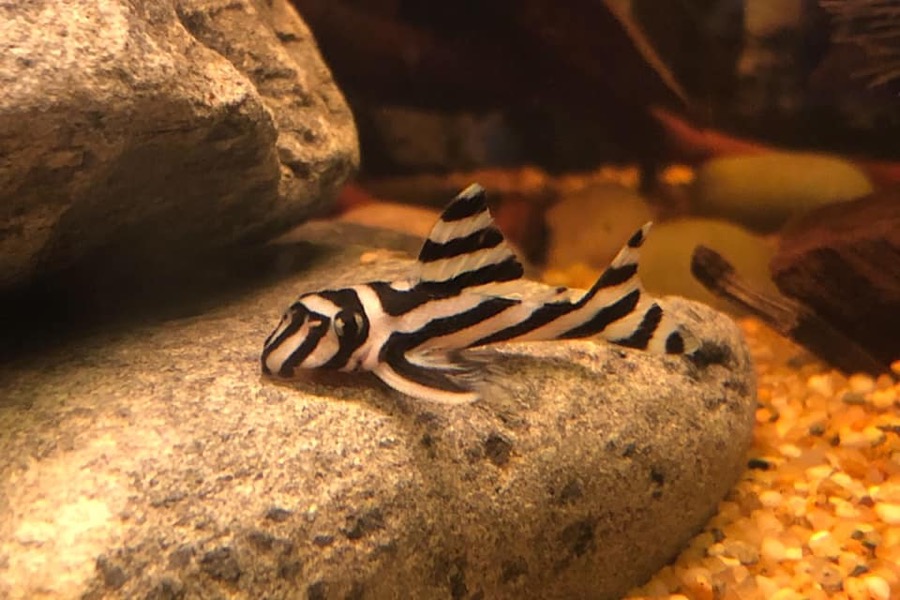
What keeping this species involves
Needs warmth, strong flow, high oxygen and a carnivorous diet, and is expensive enough that mistakes are costly. Not a first pleco.
Fast, oxygen-rich water over rocky substrate in the Xingu rapids, in crevices rather than open water.
Identity and names
- Common name
- Zebra pleco
- Scientific name
- Hypancistrus zebra
- Family
- Loricariidae
- Order
- Siluriformes
- Class
- Actinopterygii
- Also sold as
- L046, L 46, imperial pleco, Hypancistrus zebra
Adult size and growth
6–7 cm (2.4–2.8 in) — FishBase records a maximum of 7.0 cm TL. A small fish with a long life.
Typical lifespan in an aquarium: 10–15 years. Almost every animal sold in a shop is a juvenile, so the tank has to suit the size in the first line rather than the size in the bag.
Shape, which is what the compatibility engine reads instead of length alone: depressed — flattened top to bottom with a grazing or sucking mouth. Assigned from what is typical of Loricariidae, not examined for this species.
Water and tank requirements
Floor area and caves rather than swimming length. A group needs enough separate crevices that individuals are not forced into contact.
Temperature (°C)
Scale: 0 to 36 °C.
pH (pH)
Scale: 4 to 9.5 pH.
Hardness (°dGH)
Scale: 0 to 30 °dGH.
Where these figures come from
Habitat class
Clearwater lowland river — the Rio Xingu rapids
Transparent, mineral-poor rivers draining ancient shield geology — the Tapajós and Xingu type — with low sediment and good light penetration.
Soft water with more movement and more oxygen than a forest stream. Species from here generally want current and open swimming room as much as they want the chemistry.
- Conductivity
- 20–100 µS/cm
- Flow
- moderate
- Dissolved oxygen
- near saturation
- Seasonality
- strong
These are figures for the KIND of water body, not measurements of this species. They are AquariumHQ’s summary of the general limnology and are given wide because the water is.
- TemperatureFollows the habitat this animal comes from
- Follows the water this animal is recorded from — the Rio Xingu rapids. Clearwater lowland river generally runs 24–30°C, and the advised band of 26–30°C is consistent with it. This is AquariumHQ's reasoning from the habitat, not a measurement of the species. A source does publish a figure for this parameter, and it answers a different question — an environmental range or a laboratory tolerance rather than a keeping recommendation. It is held alongside this band rather than behind it.
- pHFollows the habitat this animal comes from
- Follows the water this animal is recorded from — the Rio Xingu rapids. Clearwater lowland river generally runs 6–7.5, and the advised band of 6–7.2 is consistent with it. This is AquariumHQ's reasoning from the habitat, not a measurement of the species.
- General hardnessFollows the habitat this animal comes from
- Follows the water this animal is recorded from — the Rio Xingu rapids. Clearwater lowland river generally runs 1–8 dGH, and the advised band of 2–10 dGH is consistent with it. This is AquariumHQ's reasoning from the habitat, not a measurement of the species.
Scale: 23.1 to 30.9 °C.
Scale: 5.8 to 7.7 pH.
Scale: -0.3 to 11.4 dGH.
| Requirement | Value | Notes |
|---|---|---|
| Temperature | 26–30 °C (79–86 °F) | Stability matters more than hitting an exact figure. |
| pH | 6–7.2 | A stable pH outside the ideal band is usually better than an unstable one inside it. |
| General hardness | 2–10 °dGH | Check your supplier's published figure before choosing species. |
| Minimum volume | 90 L (24 US gal) | A floor, not a recommendation. |
| Minimum footprint | 75 cm long × 40 cm deep | Floor area and caves rather than swimming length. A group needs enough separate crevices that individuals are not forced into contact. |
| Water flow | high | Match the outflow to this rather than to the filter's rating. |
| Lid required | Recommended | Reduces evaporation and prevents accidents. |
| Structure | Rock and slate caves with strong flow and high oxygenation. Bare or fine sand substrate; this fish lives in and around structure, not over open ground. |
Behaviour
- Occupies caves and crevices during the day and forages at night.
- Sensitive to low oxygen — this is a rapids fish and it shows in how it behaves when flow drops.
Feeding
NOT an algae eater. Hypancistrus are carnivores, and a zebra pleco fed as though it were a Panaque or an Ancistrus will slowly starve while the tank looks clean.
- Diet type
- Carnivore
- Staples
- Frozen bloodworm, Sinking carnivore pellets, Frozen brine shrimp, Live blackworm
Breeding
- Strategy
- Cave-spawning; the male guards and fans the eggs
- Difficulty
- challenging
- Parental care
- guarding
Bred commercially in some numbers, which is the only reason the species is available at all — wild export from Brazil has been prohibited since 2004.
Tankmates and compatibility
Assessments are derived from stored traits by the compatibility engine, with the reasoning shown. A verdict is a statement about probability, not a guarantee — individual temperament can override it.
| Towards | Risk | What it means |
|---|---|---|
| Small fish | none | Anything that fits in the mouth is at risk once this species reaches adult size. |
| Adult dwarf shrimp | none | Cover reduces losses but rarely prevents them where the risk is high. |
| Shrimplets | low | Determines whether a shrimp colony can grow rather than merely persist. |
| Snails | none | Applies to snails you wanted as well as snails you did not. |
| Long or trailing fins | none | Fin damage is an entry point for secondary infection. |
| Plants | none | Tough species such as Anubias and Java fern survive most grazers. |
Any pair in the catalogue can be assessed with the compatibility checker.
Welfare considerations
Points where the way this species is commonly sold or kept differs from what it actually needs.
- Listed as endangered by the IUCN and subject to Brazilian export restriction. Buy captive-bred stock and ask where it came from.
- Fed as an algae eater it starves slowly. This is the commonest way the species is killed in home aquaria.
Problems to watch for
Most problems in a tank containing this species are general rather than species-specific. Start with the troubleshooting index and work from the observation rather than from a guess at the cause.
What AquariumHQ does not yet hold
Species-level disease susceptibility is modelled in the graph and is not yet populated. Health pages will not be published until each condition has veterinary sourcing, because health content written without evidence is the most harmful thing this product could publish. The gap is recorded in the coverage report.
Where it comes from
- Native range
- Rio Xingu, Pará, Brazil — a single river system
- Habitat
- Fast, oxygen-rich water over rocky substrate in the Xingu rapids, in crevices rather than open water.
What the checklists say
5 distribution statements retrieved from GBIF checklists. Establishment means is reproduced from the source where it states one, and left unstated where it does not — a record of presence is not a record of origin.
| Status | Places | What this means |
|---|---|---|
| Native | 1 | A checklist states the species occurs here naturally. |
| Introduced | 2 | A checklist states the species arrived here with human help. That is not a statement that it is established, harmful or illegal. |
| Recorded as present, establishment means not stated | 2 | The source records the species as present and does not say whether it is native or introduced. AquariumHQ does not fill that in. |
Evidence
Every stored value with the kind of support behind it and where to check it. Evidence type and confidence are separate axes: an editorial position held confidently and a measurement held tentatively are different things.
| Claim | Value | Evidence type | Confidence | Source |
|---|---|---|---|---|
| scientific name | Hypancistrus zebra | Observed / measured | high confidence | Catalogue of Life; GBIF — Global Biodiversity Information Facility |
| native range | Rio Xingu, Pará, Brazil — a single river system | Observed / measured | moderate confidence | GBIF — Global Biodiversity Information Facility |
| adult size | 6–7 cm | Aquarium-literature consensus | moderate confidence | AquariumHQ husbandry synthesis |
| lifespan | 10–15 years | Aquarium-literature consensus | moderate confidence | AquariumHQ husbandry synthesis |
| temperature | 26–30 °C | Aquarium-literature consensus | moderate confidence | AquariumHQ husbandry synthesis |
| ph | 6–7.2 pH | Aquarium-literature consensus | moderate confidence | AquariumHQ husbandry synthesis |
| general hardness | 2–10 °dGH | Aquarium-literature consensus | moderate confidence | AquariumHQ husbandry synthesis |
| minimum tank volume | ≥ 90 L | AquariumHQ editorial position | moderate confidence | AquariumHQ husbandry synthesis |
| minimum tank length | ≥ 75 cm | AquariumHQ editorial position | moderate confidence | AquariumHQ husbandry synthesis |
| minimum group size | ≥ 3 | AquariumHQ editorial position | moderate confidence | AquariumHQ husbandry synthesis |
Last reviewed 2026-08-10. Values labelled as an aquarium-literature consensus are AquariumHQ editorial positions rather than measurements — see how evidence is handled.
Why we say this
What each figure on this page rests on, and how far that is from being independently established.
Every figure on this page has a provenance. Open any claim to see what AquariumHQ holds for it, which sources say what, and what a claim of that kind actually needs. Different claims need different evidence: an accepted scientific name is settled by one authority, while a legal restriction needs a current primary instrument. A single source is often the right answer rather than a thin one.
scientific nameAquariumHQ's own position, externally checkableBased on a verified authoritative source.
AquariumHQ's own position on a claim an external source could support.
What this kind of claim needs: accepted scientific name and classification — 1 authoritative source in an appropriate context. Checked against gbif on 2026-08-11. One authoritative backbone is what this class requires.
What would improve this: Go and read a source. This is reachable and has not been reached.
native rangeAquariumHQ's own position, externally checkableBased on a verified authoritative source.
AquariumHQ's own position on a claim an external source could support.
What this kind of claim needs: where the species occurs — 1 authoritative source in an appropriate context. 5 distribution statements held from GBIF checklists — native in 1, introduced in 2 countries. Establishment means is reproduced from the source, never inferred from occurrence.
What would improve this: Go and read a source. This is reachable and has not been reached.
adult sizeOne sourceBased on a verified authoritative source.1 citation, 1 independent origin
A single source: giarrizzo-2015-xingu.
- 7 cm — FishBase · Maximum recorded · The range the species is recorded from · checked 2026-08-11
What this kind of claim needs: size a well-kept specimen reaches — no external source is required, provided AquariumHQ shows its reasoning. One authoritative source, which is what this kind of claim requires. Independent replication would be welcome and is not the standard.
What would improve this: Corroborate against a second, independent source.
lifespanAquariumHQ's own position, externally checkableAquariumHQ's own position, derived from evidenced inputs.
AquariumHQ's own position on a claim an external source could support.
What this kind of claim needs: what aquariumhq advises for keeping — no external source is required, provided AquariumHQ shows its reasoning. No external source is required for this class. AquariumHQ's position stands on its stated reasoning.
What would improve this: Go and read a source. This is reachable and has not been reached.
temperatureOne sourceAquariumHQ's own position, derived from evidenced inputs.1 citation, 1 independent origin
A single source: aquarien-atlas.
- 23–26 °C — FishBase · Tolerated range · The range the species is recorded from · checked 2026-08-11
What this kind of claim needs: what aquariumhq advises for keeping — no external source is required, provided AquariumHQ shows its reasoning. Derived from the observed range rather than copied from it. RAISED BY THE GATE ON A BRAND-NEW RECORD, which is the point of running the audit at intake rather than three sprints later. AquariumHQ's authored band is 26–30 °C; FishBase records 23–26 °C. The hobby keeps this species firmly at the warm end and the Rio Xingu is a warm river, so a 23–26 °C environmental record reads like a collection artefact — but that is a hypothesis about the source, not evidence, and it is exactly the reasoning that produced the oscar's still-open question. The advised band stands and the disagreement is recorded rather than smoothed away.
What would improve this: Corroborate against a second, independent source.
phChecked — this source does not publish itAquariumHQ's own position, derived from evidenced inputs.
A source was opened and checked for this, and does not publish it.
Checked and not published. Checked in the environment field. FishBase publishes no pH range for this species.
What this kind of claim needs: what aquariumhq advises for keeping — no external source is required, provided AquariumHQ shows its reasoning. No external source is required for this class. AquariumHQ's position stands on its stated reasoning.
What would improve this: Look elsewhere. This source has been exhausted for this claim.
general hardnessChecked — this source does not publish itAquariumHQ's own position, derived from evidenced inputs.
A source was opened and checked for this, and does not publish it.
Checked and not published. Checked in the environment field. FishBase publishes no dH range for this species.
What this kind of claim needs: what aquariumhq advises for keeping — no external source is required, provided AquariumHQ shows its reasoning. No external source is required for this class. AquariumHQ's position stands on its stated reasoning.
What would improve this: Look elsewhere. This source has been exhausted for this claim.
minimum tank volumeAquariumHQ's judgement — no authority publishes thisAquariumHQ's own position, derived from evidenced inputs.
No external authority publishes this. The rationale carries the reasoning.
What this kind of claim needs: minimum tank size — no external source is required, provided AquariumHQ shows its reasoning. No authority publishes this. AquariumHQ derives it, and the derivation is recorded with its inputs and assumptions.
What would improve this: Keep the rationale current. There is no source to find.
minimum tank lengthAquariumHQ's judgement — no authority publishes thisAquariumHQ's own position, derived from evidenced inputs.
No external authority publishes this. The rationale carries the reasoning.
What this kind of claim needs: minimum tank size — no external source is required, provided AquariumHQ shows its reasoning. No authority publishes this. AquariumHQ derives it, and the derivation is recorded with its inputs and assumptions.
What would improve this: Keep the rationale current. There is no source to find.
minimum group sizeAquariumHQ's judgement — no authority publishes thisAquariumHQ's own position, derived from evidenced inputs.
No external authority publishes this. The rationale carries the reasoning.
What this kind of claim needs: group size — no external source is required, provided AquariumHQ shows its reasoning. No external source is required for this class. AquariumHQ's position stands on its stated reasoning.
What would improve this: Keep the rationale current. There is no source to find.
Guides relevant to this species
Chosen from this record's own traits rather than listed on every page.
- Schooling and shoalingThis species is recorded as loose group, and the number it is kept in decides how it behaves.
- The kinds of water aquarium fish come fromThis record's water bands follow clearwater lowland river, which is the kind of water this animal is recorded from.
Group size and social behaviour
Not a shoaling fish, and not solitary either — males hold caves and tolerate neighbours when there are enough caves to go round. Conflict in this species is usually a shortage of hiding places rather than temperament.