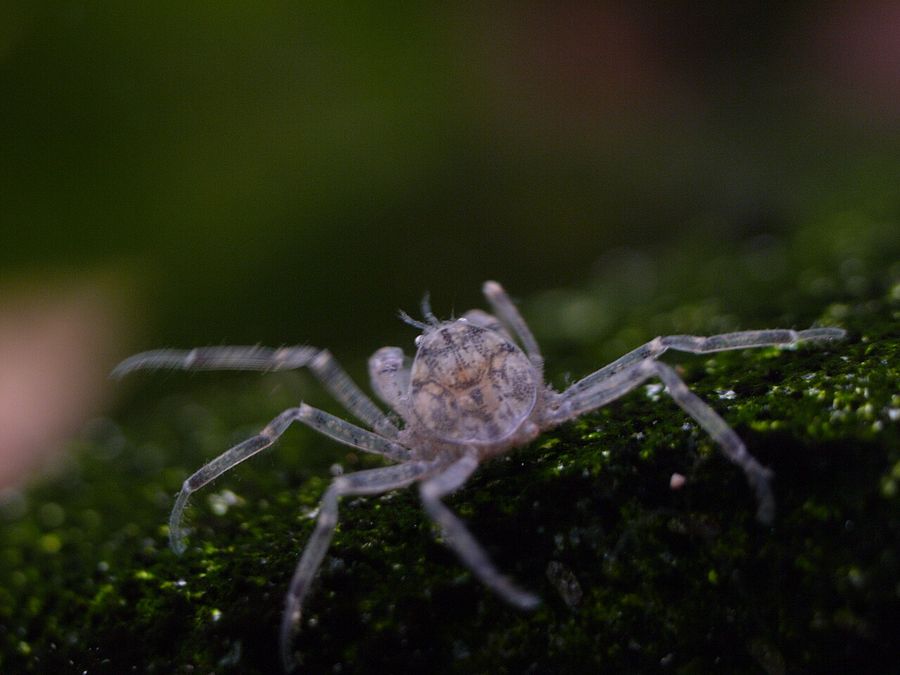
Thai micro crab
A crab with a body about the size of a lentil that lives in floating plant roots and filters particles out of the water with hairy claws. Almost uniquely among aquarium crabs it is fully freshwater and needs no land, and almost uniquely among aquarium animals its water requirements have never been established.
Quick profile
- Scientific name
- Limnopilos naiyanetri
- Adult size
- 1 cm (0.4–0.4 in)
- Lifespan
- 1–2 years
- Temperature
- Not established — no defensible keeping range
- pH
- Not established — no defensible keeping range
- Hardness
- Not established — no defensible keeping range
- Minimum tank
- 20 L (5 US gal)
- Minimum length
- 30 cm
- Swimming zone
- Midwater
- Social
- Loose group — at least 5
- Diet
- Filter feeder
- Overall confidence
- low confidence
What keeping this species involves
Small enough to be eaten by almost anything, dependent on suspended food most keepers filter out, and published with no established water requirements. None of that is difficult; all of it has to be planned for.
Among the trailing root masses of floating water hyacinth in slow lowland river channels, where it spends its life off the substrate.
Identity and names
- Common name
- Thai micro crab
- Scientific name
- Limnopilos naiyanetri
- Family
- Hymenosomatidae
- Order
- Decapoda
- Class
- Malacostraca
- Also sold as
- false spider crab, Thai micro spider crab, Limnopilos naiyanetri
Adult size and growth
1 cm (0.4–0.4 in) — Carapace width, roughly 1 cm, with a leg span of about 2.5 cm. One of the smallest animals in the catalogue.
Typical lifespan in an aquarium: 1–2 years. Almost every animal sold in a shop is a juvenile, so the tank has to suit the size in the first line rather than the size in the bag.
Shape, which is what the compatibility engine reads instead of length alone: depressed — flattened top to bottom with a grazing or sucking mouth. Assigned from what is typical of Hymenosomatidae, not examined for this species.
Water and tank requirements
A filter-feeder that lives in suspended root masses needs volume with something to cling to in it rather than floor area. The footprint here is set by what can carry a stable mature filter feeding it, not by the animal's own size.
Where these figures come from
Habitat class
Not established
AquariumHQ has not established what kind of water this animal comes from.
Nothing follows from the habitat, because the habitat is not held. Whatever band the record publishes rests on something else, and the record says what.
These are figures for the KIND of water body, not measurements of this species. They are AquariumHQ’s summary of the general limnology and are given wide because the water is.
- TemperatureNo keeping range held
- AquariumHQ publishes no temperature range for this species and records why.
- pHNo keeping range held
- AquariumHQ publishes no ph range for this species and records why.
- General hardnessNo keeping range held
- AquariumHQ publishes no general hardness range for this species and records why.
| Requirement | Value | Notes |
|---|---|---|
| Temperature | Not established — no defensible keeping range | Figures exist, and none of them supports a keeping recommendation honestly — they measure where the animal was collected rather than how it should be kept. AquariumHQ publishes no range rather than relabelling one. Figures circulate widely and all of them trace to generic tropical-community assumptions rather than to any measurement of this species. Keepers report success across the ordinary tropical band; treat stability and the absence of predators as the things that matter, and change nothing quickly. |
| pH | Not established — no defensible keeping range | Figures exist, and none of them supports a keeping recommendation honestly — they measure where the animal was collected rather than how it should be kept. AquariumHQ publishes no range rather than relabelling one. No source AquariumHQ holds publishes a pH for this species. Its habitat is lowland Thai river water rather than blackwater, so extremes in either direction are unlikely to suit it, and a stable middling figure is the defensible choice until somebody measures one. |
| General hardness | Not established — no defensible keeping range | Figures exist, and none of them supports a keeping recommendation honestly — they measure where the animal was collected rather than how it should be kept. AquariumHQ publishes no range rather than relabelling one. Unestablished. As a crustacean it needs dissolved minerals to moult, so very soft water is a plausible risk rather than a documented one — provide moderate hardness and watch for failed moults rather than trusting a figure nobody has published. |
| Minimum volume | 20 L (5 US gal) | A floor, not a recommendation. |
| Minimum footprint | 30 cm long | A filter-feeder that lives in suspended root masses needs volume with something to cling to in it rather than floor area. The footprint here is set by what can carry a stable mature filter feeding it, not by the animal's own size. |
| Water flow | low | Match the outflow to this rather than to the filter's rating. |
| Lid required | Recommended | Reduces evaporation and prevents accidents. |
| Structure | Floating plants with long trailing roots, moss and fine-leaved cover. This animal lives in suspended vegetation and has almost no use for the substrate. |
Behaviour
- Clings to floating roots and moss rather than walking the substrate.
- Holds its claws into the current and fans, which is feeding rather than display.
Feeding
Fans the water with setae on its claws and takes what it catches. A tank clean enough to have nothing in suspension starves it, which is the opposite of most aquarium advice.
- Diet type
- Filter feeder
- Staples
- Suspended particulate matter and biofilm, Powdered filter-feeder foods, Infusoria and green water
Breeding
- Strategy
- Female carries eggs beneath the abdomen; larval requirements not established
- Difficulty
- rarely achieved
- Parental care
- carries eggs
Berried females are seen in aquaria and the young are not reared. Whether the larvae need conditions the tank does not supply is unknown, which is the same gap as the water parameters.
Tankmates and compatibility
Assessments are derived from stored traits by the compatibility engine, with the reasoning shown. A verdict is a statement about probability, not a guarantee — individual temperament can override it.
| Towards | Risk | What it means |
|---|---|---|
| Small fish | none | Anything that fits in the mouth is at risk once this species reaches adult size. |
| Adult dwarf shrimp | none | Cover reduces losses but rarely prevents them where the risk is high. |
| Shrimplets | none | Determines whether a shrimp colony can grow rather than merely persist. |
| Snails | none | Applies to snails you wanted as well as snails you did not. |
| Long or trailing fins | none | Fin damage is an entry point for secondary infection. |
| Plants | none | Tough species such as Anubias and Java fern survive most grazers. |
Any pair in the catalogue can be assessed with the compatibility checker.
Welfare considerations
Points where the way this species is commonly sold or kept differs from what it actually needs.
- Wild-caught. There is no established captive breeding, so every animal sold is taken from one river basin in central Thailand.
- Too small to keep with fish of almost any size. Even fish that do not hunt will take one that fits.
- AquariumHQ publishes no temperature, pH or hardness range for this species because none has been established. That is a gap in the evidence and not a sign that the animal tolerates anything — match a stable, ordinary tropical tank and change conditions slowly.
Problems to watch for
Most problems in a tank containing this species are general rather than species-specific. Start with the troubleshooting index and work from the observation rather than from a guess at the cause.
What AquariumHQ does not yet hold
Species-level disease susceptibility is modelled in the graph and is not yet populated. Health pages will not be published until each condition has veterinary sourcing, because health content written without evidence is the most harmful thing this product could publish. The gap is recorded in the coverage report.
Where it comes from
- Native range
- Tha Chin river basin, central Thailand — endemic
- Habitat
- Among the trailing root masses of floating water hyacinth in slow lowland river channels, where it spends its life off the substrate.
What the checklists say
2 distribution statements retrieved from GBIF checklists. Establishment means is reproduced from the source where it states one, and left unstated where it does not — a record of presence is not a record of origin.
| Status | Places | What this means |
|---|---|---|
| Introduced | 1 | A checklist states the species arrived here with human help. That is not a statement that it is established, harmful or illegal. |
| Recorded as present, establishment means not stated | 1 | The source records the species as present and does not say whether it is native or introduced. AquariumHQ does not fill that in. |
No checklist AquariumHQ holds positively calls this species native anywhere, so the native range above rests on AquariumHQ’s own reading of the literature rather than on a cited checklist.
Evidence
Every stored value with the kind of support behind it and where to check it. Evidence type and confidence are separate axes: an editorial position held confidently and a measurement held tentatively are different things.
| Claim | Value | Evidence type | Confidence | Source |
|---|---|---|---|---|
| scientific name | Limnopilos naiyanetri | Observed / measured | high confidence | Catalogue of Life; GBIF — Global Biodiversity Information Facility |
| native range | Tha Chin river basin, central Thailand — endemic | Observed / measured | moderate confidence | GBIF — Global Biodiversity Information Facility |
| adult size | 1 cm | Aquarium-literature consensus | low confidence | AquariumHQ husbandry synthesis |
| lifespan | 1–2 years | Aquarium-literature consensus | low confidence | AquariumHQ husbandry synthesis |
| temperature | — | Insufficient evidence | confidence unknown | — |
| ph | — | Insufficient evidence | confidence unknown | — |
| general hardness | — | Insufficient evidence | confidence unknown | — |
| minimum tank volume | ≥ 20 L | AquariumHQ editorial position | moderate confidence | AquariumHQ husbandry synthesis |
| minimum tank length | ≥ 30 cm | AquariumHQ editorial position | moderate confidence | AquariumHQ husbandry synthesis |
| minimum group size | ≥ 5 | AquariumHQ editorial position | low confidence | AquariumHQ husbandry synthesis |
Last reviewed 2026-08-10. Values labelled as an aquarium-literature consensus are AquariumHQ editorial positions rather than measurements — see how evidence is handled.
Why we say this
What each figure on this page rests on, and how far that is from being independently established.
Every figure on this page has a provenance. Open any claim to see what AquariumHQ holds for it, which sources say what, and what a claim of that kind actually needs. Different claims need different evidence: an accepted scientific name is settled by one authority, while a legal restriction needs a current primary instrument. A single source is often the right answer rather than a thin one.
scientific nameAquariumHQ's own position, externally checkableBased on a verified authoritative source.
AquariumHQ's own position on a claim an external source could support.
What this kind of claim needs: accepted scientific name and classification — 1 authoritative source in an appropriate context. Checked against gbif on 2026-08-12. One authoritative backbone is what this class requires.
What would improve this: Go and read a source. This is reachable and has not been reached.
native rangeAquariumHQ's own position, externally checkableBased on a verified authoritative source.
AquariumHQ's own position on a claim an external source could support.
What this kind of claim needs: where the species occurs — 1 authoritative source in an appropriate context. 2 distribution statements held from GBIF checklists — introduced in 1 country. Establishment means is reproduced from the source, never inferred from occurrence.
What would improve this: Go and read a source. This is reachable and has not been reached.
adult sizeAquariumHQ's own position, externally checkableAquariumHQ's own position, derived from evidenced inputs.
AquariumHQ's own position on a claim an external source could support.
What this kind of claim needs: size a well-kept specimen reaches — no external source is required, provided AquariumHQ shows its reasoning. No external source is required for this class. AquariumHQ's position stands on its stated reasoning.
What would improve this: Go and read a source. This is reachable and has not been reached.
lifespanAquariumHQ's own position, externally checkableAquariumHQ's own position, derived from evidenced inputs.
AquariumHQ's own position on a claim an external source could support.
What this kind of claim needs: what aquariumhq advises for keeping — no external source is required, provided AquariumHQ shows its reasoning. No external source is required for this class. AquariumHQ's position stands on its stated reasoning.
What would improve this: Go and read a source. This is reachable and has not been reached.
temperatureAquariumHQ's own position, externally checkableAquariumHQ's own position, derived from evidenced inputs.
AquariumHQ's own position on a claim an external source could support.
What this kind of claim needs: what aquariumhq advises for keeping — no external source is required, provided AquariumHQ shows its reasoning. No external source is required for this class. AquariumHQ's position stands on its stated reasoning.
What would improve this: Go and read a source. This is reachable and has not been reached.
phAquariumHQ's own position, externally checkableAquariumHQ's own position, derived from evidenced inputs.
AquariumHQ's own position on a claim an external source could support.
What this kind of claim needs: what aquariumhq advises for keeping — no external source is required, provided AquariumHQ shows its reasoning. No external source is required for this class. AquariumHQ's position stands on its stated reasoning.
What would improve this: Go and read a source. This is reachable and has not been reached.
general hardnessAquariumHQ's own position, externally checkableAquariumHQ's own position, derived from evidenced inputs.
AquariumHQ's own position on a claim an external source could support.
What this kind of claim needs: what aquariumhq advises for keeping — no external source is required, provided AquariumHQ shows its reasoning. No external source is required for this class. AquariumHQ's position stands on its stated reasoning.
What would improve this: Go and read a source. This is reachable and has not been reached.
minimum tank volumeAquariumHQ's judgement — no authority publishes thisAquariumHQ's own position, derived from evidenced inputs.
No external authority publishes this. The rationale carries the reasoning.
What this kind of claim needs: minimum tank size — no external source is required, provided AquariumHQ shows its reasoning. No authority publishes this. AquariumHQ derives it, and the derivation is recorded with its inputs and assumptions.
What would improve this: Keep the rationale current. There is no source to find.
minimum tank lengthAquariumHQ's judgement — no authority publishes thisAquariumHQ's own position, derived from evidenced inputs.
No external authority publishes this. The rationale carries the reasoning.
What this kind of claim needs: minimum tank size — no external source is required, provided AquariumHQ shows its reasoning. No authority publishes this. AquariumHQ derives it, and the derivation is recorded with its inputs and assumptions.
What would improve this: Keep the rationale current. There is no source to find.
minimum group sizeAquariumHQ's judgement — no authority publishes thisAquariumHQ's own position, derived from evidenced inputs.
No external authority publishes this. The rationale carries the reasoning.
What this kind of claim needs: group size — no external source is required, provided AquariumHQ shows its reasoning. No external source is required for this class. AquariumHQ's position stands on its stated reasoning.
What would improve this: Keep the rationale current. There is no source to find.
Guides relevant to this species
Chosen from this record's own traits rather than listed on every page.
- Schooling and shoalingThis species is recorded as loose group, and the number it is kept in decides how it behaves.
Group size and social behaviour
Gregarious and entirely non-territorial. Kept in ones and twos it is almost never seen; a group in a dense root mass is visible and behaves normally.