Oscar
A 35 cm cichlid with genuine individual character and an appetite to match. Sold at 5 cm into tanks that will be inadequate within a year, and one of the most commonly rehomed fish in the hobby.
Quick profile
- Scientific name
- Astronotus ocellatus
- Adult size
- 30–40 cm (11.8–15.7 in)
- Lifespan
- 10–15 years
- Temperature
- 24–29 °C (75–84 °F)
- pH
- 6–7.8
- Hardness
- 3–18 °dGH
- Minimum tank
- 450 L (119 US gal)
- Minimum length
- 150 cm
- Swimming zone
- All levels
- Social
- Solitary
- Diet
- Carnivore
- Overall confidence
- high confidence
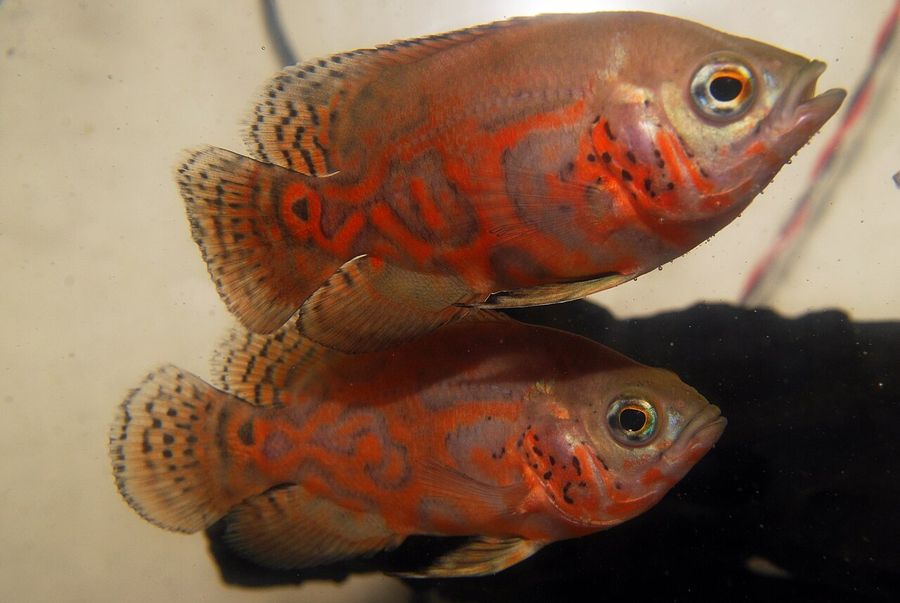
What keeping this species involves
The waste output of a 35 cm carnivore requires filtration and water changes on a different scale from a community tank.
Slow, warm, structured river margins and floodplain lakes.
Identity and names
- Common name
- Oscar
- Scientific name
- Astronotus ocellatus
- Family
- Cichlidae
- Order
- Cichliformes
- Class
- Actinopterygii
- Also sold as
- tiger oscar, velvet cichlid
Adult size and growth
30–40 cm (11.8–15.7 in) — Grows fast — 20 cm within the first year is normal.
Typical lifespan in an aquarium: 10–15 years. Almost every animal sold in a shop is a juvenile, so the tank has to suit the size in the first line rather than the size in the bag.
Shape, which is what the compatibility engine reads instead of length alone: deep-bodied with a large — a piscivore's mouth. The reference case in the aquarium hobby for a fish that eats its tankmates. The gape is genuinely large for a cichlid.
Water and tank requirements
A 35 cm fish needs a tank in which it can turn round and accelerate. 150 cm × 60 cm is the practical minimum for one adult and there is no version of this species that fits a 200 L tank.
Temperature (°C)
Scale: 0 to 36 °C.
pH (pH)
Scale: 4 to 9.5 pH.
Hardness (°dGH)
Scale: 0 to 30 °dGH.
Where these figures come from
Habitat class
Lowland floodplain
Seasonally inundated flat country — várzea, chaco, swamp margin — where the water body changes size, depth and chemistry through the year.
The habitat's defining feature is change, so a single band describes it badly. Species from here are generally tolerant of a wide range and intolerant of nothing much — which makes them easy to keep and easy to keep wrongly.
- Conductivity
- 40–300 µS/cm
- Flow
- still
- Dissolved oxygen
- low
- Seasonality
- strong
These are figures for the KIND of water body, not measurements of this species. They are AquariumHQ’s summary of the general limnology and are given wide because the water is.
- TemperatureFollows the habitat this animal comes from
- Follows the water this animal is recorded from — lowland floodplain. Lowland floodplain generally runs 22–32°C, and the advised band of 24–29°C is consistent with it. This is AquariumHQ's reasoning from the habitat, not a measurement of the species. A source does publish a figure for this parameter, and it answers a different question — an environmental range or a laboratory tolerance rather than a keeping recommendation. It is held alongside this band rather than behind it.
- pHFollows the habitat this animal comes from
- Follows the water this animal is recorded from — lowland floodplain. Lowland floodplain generally runs 6–7.5, and the advised band of 6–7.8 is consistent with it. This is AquariumHQ's reasoning from the habitat, not a measurement of the species. A source does publish a figure for this parameter, and it answers a different question — an environmental range or a laboratory tolerance rather than a keeping recommendation. It is held alongside this band rather than behind it.
- General hardnessFollows the habitat this animal comes from
- Follows the water this animal is recorded from — lowland floodplain. Lowland floodplain generally runs 2–12 dGH, and the advised band of 3–18 dGH is consistent with it. This is AquariumHQ's reasoning from the habitat, not a measurement of the species. A source does publish a figure for this parameter, and it answers a different question — an environmental range or a laboratory tolerance rather than a keeping recommendation. It is held alongside this band rather than behind it.
Scale: 20.5 to 33.5 °C.
Scale: 5.7 to 8.1 pH.
Scale: -0.4 to 20.4 dGH.
| Requirement | Value | Notes |
|---|---|---|
| Temperature | 24–29 °C (75–84 °F) | Stability matters more than hitting an exact figure. |
| pH | 6–7.8 | A stable pH outside the ideal band is usually better than an unstable one inside it. |
| General hardness | 3–18 °dGH | Check your supplier's published figure before choosing species. |
| Minimum volume | 450 L (119 US gal) | A floor, not a recommendation. |
| Minimum footprint | 150 cm long × 60 cm deep | A 35 cm fish needs a tank in which it can turn round and accelerate. 150 cm × 60 cm is the practical minimum for one adult and there is no version of this species that fits a 200 L tank. |
| Water flow | moderate | Match the outflow to this rather than to the filter's rating. |
| Lid required | Yes | This species jumps. |
| Structure | Heavy, stable hardscape. Anything movable gets moved. |
Behaviour
- Rearranges substrate and decor deliberately.
- Recognises and responds to individual people — one of the reasons it is so often bought and so often outgrown.
Feeding
- Diet type
- Carnivore
- Staples
- Large cichlid pellets, Frozen prawn and mussel, Earthworms
- Avoid
- Feeder fish — a disease vector with no nutritional advantage, Mammalian meat such as beef heart as a staple
Breeding
- Strategy
- Substrate spawner; both parents guard
- Difficulty
- challenging
- Parental care
- guarding
Tankmates and compatibility
Assessments are derived from stored traits by the compatibility engine, with the reasoning shown. A verdict is a statement about probability, not a guarantee — individual temperament can override it.
| Towards | Risk | What it means |
|---|---|---|
| Small fish | near-certain | Anything that fits in the mouth is at risk once this species reaches adult size. |
| Adult dwarf shrimp | near-certain | Cover reduces losses but rarely prevents them where the risk is high. |
| Shrimplets | near-certain | Determines whether a shrimp colony can grow rather than merely persist. |
| Snails | high | Applies to snails you wanted as well as snails you did not. |
| Long or trailing fins | none | Fin damage is an entry point for secondary infection. |
| Plants | uproots | Tough species such as Anubias and Java fern survive most grazers. |
Assessed pairings
Any pair in the catalogue can be assessed with the compatibility checker.
Welfare considerations
Points where the way this species is commonly sold or kept differs from what it actually needs.
- 'Hole-in-the-head' erosion is common in oscars and is associated with poor water quality and inadequate diet rather than being an inevitable disease.
- Feeder fish are a significant disease and nutrition risk. Do not use them.
Problems to watch for
Most problems in a tank containing this species are general rather than species-specific. Start with the troubleshooting index and work from the observation rather than from a guess at the cause.
What AquariumHQ does not yet hold
Species-level disease susceptibility is modelled in the graph and is not yet populated. Health pages will not be published until each condition has veterinary sourcing, because health content written without evidence is the most harmful thing this product could publish. The gap is recorded in the coverage report.
Where it comes from
- Native range
- Amazon and Orinoco basins
- Habitat
- Slow, warm, structured river margins and floodplain lakes.
What the checklists say
28 distribution statements retrieved from GBIF checklists. Establishment means is reproduced from the source where it states one, and left unstated where it does not — a record of presence is not a record of origin.
| Status | Places | What this means |
|---|---|---|
| Native | 4 | A checklist states the species occurs here naturally. |
| Introduced | 14 | A checklist states the species arrived here with human help. That is not a statement that it is established, harmful or illegal. |
| Recorded as present, establishment means not stated | 10 | The source records the species as present and does not say whether it is native or introduced. AquariumHQ does not fill that in. |
Legal status and responsible practice
Where this species has been introduced, and what followed
Two databases on two continents hold records for this species, and they are not two accounts of one event. They are separate introductions with separate causes, and the differences between them are the most informative thing on this panel.
Florida and Hawaii
EstablishedThe first Florida records resulted from deliberate stockings by an aquarium fish farm in the late 1950s, alongside an attempt to popularise the species as a sport fish under the name 'velvet cichlid'. Anglers have since aided dispersal by moving fish to new locations. The Hawaii introduction was for recreational fishing in 1952.
- Deliberate stockingSomebody put the species into open water on purpose, for food, angling, ornament or mosquito control — frequently a government agency, and frequently before anyone considered the consequences.
- Escape from an ornamental fish farmOrnamental fish farms are usually outdoor ponds in warm places, and warm places are where tropical species establish. Several of the best-known Florida introductions began this way rather than with a keeper.
- Spread from an existing introduced populationMovement along connected water from a population already established. This is why a single introduction is not a single event.
What has been established
- Competition with native speciesInferred from the animal's biologyConsidered a potential competitor with native sunfishes for food and possibly for spawning areas, and a predator on native fishes and invertebrates.USGS Nonindigenous Aquatic Species database credits: Courtenay and Hensley 1979a
- Human health consequenceReported in the literatureIncluded in a 1993 Florida health advisory on mercury in freshwater fish, with limited consumption recommended for parts of south Florida. An impact of the environment on the fish rather than the other way round, and recorded because it is what the source records.
USGS Nonindigenous Aquatic Species database · Species Profile — Means of Introduction; Species Profile — Impact of Introduction · read 2026-08-29. A United States database: the routes and effects recorded here are the ones documented there, and say nothing about other regions.
Europe — Italy from 1996, also Germany, France, the Netherlands and Poland
Recorded, not establishedOther intentional release, in five countries. A tropical cichlid in northern Europe is a fish that was let go and did not survive the winter, and the record reflects that.
- Deliberate stockingSomebody put the species into open water on purpose, for food, angling, ornament or mosquito control — frequently a government agency, and frequently before anyone considered the consequences.
What has been established
Nothing. The species is present outside its native range and no study has measured what it does there. The absence of data is not the absence of effect — it means the question has not been asked, and this is the ordinary state of the evidence for most aquarium species that have established somewhere warm.
EASIN — European Alien Species Information Network · EASIN catalogue record R01635 (apixg/catxg) · read 2026-08-30. A European network: the routes and effects recorded here are the ones documented in Europe. EASIN compiles national inventories, DAISIE and CABI rather than measuring, and its pathway assignments carry its own uncertainty flags, which are reported above where it sets them.
Never release aquarium life into the wild
Aquarium animals, plants, and aquarium water must never be released into ponds, rivers, canals, drains or the sea — not even in a country where the species is sold freely. Released fish and invertebrates establish populations that displace native species, and released plants and water carry pathogens, parasites and fragments capable of spreading without any animal at all. If you can no longer keep an animal, rehome it through an aquarium society, a retailer that accepts returns, or another keeper.
- Rehome through a local aquarium society, a specialist retailer or another keeper.
- Unwanted plants go in household waste or a hot compost heap, never in a watercourse or a garden pond.
- Never empty a bucket of tank water into a drain that discharges to open water.
- If an animal is beyond rehoming, ask an aquatic veterinarian about humane euthanasia rather than releasing it.
Legal status is recorded from the sources named and was correct on the verification date shown. Rules change, and sub-national rules often differ from national ones. Check the current position with the relevant authority before acquiring, selling or moving any animal or plant.
Evidence
Every stored value with the kind of support behind it and where to check it. Evidence type and confidence are separate axes: an editorial position held confidently and a measurement held tentatively are different things.
| Claim | Value | Evidence type | Confidence | Source |
|---|---|---|---|---|
| scientific name | Astronotus ocellatus | Observed / measured | high confidence | Catalogue of Life; GBIF — Global Biodiversity Information Facility |
| native range | Amazon and Orinoco basins | Observed / measured | moderate confidence | GBIF — Global Biodiversity Information Facility |
| adult size | 30–40 cm | Aquarium-literature consensus | high confidence | AquariumHQ husbandry synthesis |
| lifespan | 10–15 years | Aquarium-literature consensus | high confidence | AquariumHQ husbandry synthesis |
| temperature | 24–29 °C | Aquarium-literature consensus | high confidence | AquariumHQ husbandry synthesis |
| ph | 6–7.8 pH | Aquarium-literature consensus | high confidence | AquariumHQ husbandry synthesis |
| general hardness | 3–18 °dGH | Aquarium-literature consensus | high confidence | AquariumHQ husbandry synthesis |
| minimum tank volume | ≥ 450 L | AquariumHQ editorial position | moderate confidence | AquariumHQ husbandry synthesis |
| minimum tank length | ≥ 150 cm | AquariumHQ editorial position | moderate confidence | AquariumHQ husbandry synthesis |
Last reviewed 2026-08-10. Values labelled as an aquarium-literature consensus are AquariumHQ editorial positions rather than measurements — see how evidence is handled.
Why we say this
What each figure on this page rests on, and how far that is from being independently established.
Every figure on this page has a provenance. Open any claim to see what AquariumHQ holds for it, which sources say what, and what a claim of that kind actually needs. Different claims need different evidence: an accepted scientific name is settled by one authority, while a legal restriction needs a current primary instrument. A single source is often the right answer rather than a thin one.
scientific nameAquariumHQ's own position, externally checkableBased on a verified authoritative source.
AquariumHQ's own position on a claim an external source could support.
What this kind of claim needs: accepted scientific name and classification — 1 authoritative source in an appropriate context. Checked against gbif on 2026-08-11. One authoritative backbone is what this class requires.
What would improve this: Go and read a source. This is reachable and has not been reached.
native rangeAquariumHQ's own position, externally checkableBased on a verified authoritative source.
AquariumHQ's own position on a claim an external source could support.
What this kind of claim needs: where the species occurs — 1 authoritative source in an appropriate context. 28 distribution statements held from GBIF checklists — native in 4, introduced in 14 countries. Establishment means is reproduced from the source, never inferred from occurrence.
What would improve this: Go and read a source. This is reachable and has not been reached.
adult sizeSources disagreeConfirmed by more than one independent source.2 citations, 2 independent origins
Sources give values that do not reconcile. Recorded rather than averaged.
- 45.7 cm — FishBase · Maximum recorded · The range the species is recorded from · checked 2026-08-11
- 40 cm — USGS Nonindigenous Aquatic Species database · Maximum recorded · Observed in the wild · checked 2026-08-29
What this kind of claim needs: size a well-kept specimen reaches — no external source is required, provided AquariumHQ shows its reasoning. 2 independent origins.
What would improve this: Editorial resolution. More reading will not settle this on its own.
lifespanAquariumHQ's own position, externally checkableAquariumHQ's own position, derived from evidenced inputs.
AquariumHQ's own position on a claim an external source could support.
What this kind of claim needs: what aquariumhq advises for keeping — no external source is required, provided AquariumHQ shows its reasoning. No external source is required for this class. AquariumHQ's position stands on its stated reasoning.
What would improve this: Go and read a source. This is reachable and has not been reached.
temperatureOne sourceAquariumHQ's own position, derived from evidenced inputs.1 citation, 1 independent origin
A single source: aquarien-atlas.
- 22–25 °C — FishBase · Tolerated range · The range the species is recorded from · checked 2026-08-11
At least 12 degC — the source does not state an upper boundNAS publishes a lower lethal limit of 12 degC and no upper figure. The lower bound is the useful one for a fish sold into unheated tanks, and the upper is left unstated rather than guessed.
What this kind of claim needs: what aquariumhq advises for keeping — no external source is required, provided AquariumHQ shows its reasoning. Derived from the observed range rather than copied from it. AquariumHQ advises 24–29 °C; FishBase records 22–25 °C. This is the largest excursion in the catalogue against a range that is NOT a source default, so it cannot be dismissed. But it also cannot be settled here. FishBase's figure is startlingly cool for a fish native to the Amazon basin, where water is warm year-round, and a 22–25 °C environmental range for such a species has the shape of a collection artefact — a few records taken at particular sites and seasons — rather than a description of the species' thermal world. That is a hypothesis about the source, not evidence, and AquariumHQ holds no second source for oscar temperature. The advice is left standing because changing it on one contested reading would be the same error in the opposite direction.
What would improve this: Corroborate against a second, independent source.
phOne sourceAquariumHQ's own position, derived from evidenced inputs.1 citation, 1 independent origin
A single source: fishbase.
- 6–8 pH — FishBase · Tolerated range · The range the species is recorded from · checked 2026-08-11
What this kind of claim needs: what aquariumhq advises for keeping — no external source is required, provided AquariumHQ shows its reasoning. Derived from the observed range rather than copied from it. No usable species-specific observation is held for this parameter. The only figure the source publishes is one it repeats across unrelated families, which the lineage detector grades a default rather than a measurement of this fish. The advised band is therefore AquariumHQ's own position from general husbandry practice for this kind of animal, and is presented as that rather than as a sourced range.
What would improve this: Corroborate against a second, independent source.
general hardnessOne sourceAquariumHQ's own position, derived from evidenced inputs.1 citation, 1 independent origin
A single source: fishbase.
- 5–19 °dGH — FishBase · Tolerated range · The range the species is recorded from · checked 2026-08-11
What this kind of claim needs: what aquariumhq advises for keeping — no external source is required, provided AquariumHQ shows its reasoning. Derived from the observed range rather than copied from it. No usable species-specific observation is held for this parameter. The only figure the source publishes is one it repeats across unrelated families, which the lineage detector grades a default rather than a measurement of this fish. The advised band is therefore AquariumHQ's own position from general husbandry practice for this kind of animal, and is presented as that rather than as a sourced range.
What would improve this: Corroborate against a second, independent source.
minimum tank volumeAquariumHQ's judgement — no authority publishes thisAquariumHQ's own position, derived from evidenced inputs.
No external authority publishes this. The rationale carries the reasoning.
What this kind of claim needs: minimum tank size — no external source is required, provided AquariumHQ shows its reasoning. No authority publishes this. AquariumHQ derives it, and the derivation is recorded with its inputs and assumptions.
What would improve this: Keep the rationale current. There is no source to find.
minimum tank lengthAquariumHQ's judgement — no authority publishes thisAquariumHQ's own position, derived from evidenced inputs.
No external authority publishes this. The rationale carries the reasoning.
What this kind of claim needs: minimum tank size — no external source is required, provided AquariumHQ shows its reasoning. No authority publishes this. AquariumHQ derives it, and the derivation is recorded with its inputs and assumptions.
What would improve this: Keep the rationale current. There is no source to find.
Guides relevant to this species
Chosen from this record's own traits rather than listed on every page.
- Predator and prey sizeIt takes fish that fit in its mouth, and its mouth grows with it.
- Territorial behaviourIt defends ground, and the shape of what it defends decides the tank more than the volume does.
- The kinds of water aquarium fish come fromThis record's water bands follow lowland floodplain, which is the kind of water this animal is recorded from.
- Why fish size figures disagreeA documented maximum and a typical adult size are both held for this species, and they are different quantities.
- How aquarium species get into the wildThis species has a documented introduction outside its native range, with the route recorded.
- Rehoming an animal you can no longer keepThis animal reaches 40 cm. Most of the difficult rehoming cases are fish sold small that were always going to become impossible.
Group size and social behaviour
Kept singly or as an established pair. Two unpaired adults in one tank is a fight.