AquariumHQ
Search
FishfreshwaterDemandingHigh invasive risk

Walking catfish

An air-breathing catfish that can cross land between water bodies using its pectoral spines, and which became one of the most notorious aquarium-trade introductions in North America. It is hardy to an extraordinary degree and is a predator of everything smaller than itself.

Quick profile

Scientific name
Clarias batrachus
Adult size
30–47 cm (11.8–18.5 in)
Lifespan
8–12 years
Temperature
20–30 °C (68–86 °F)
pH
6–8
Hardness
3–20 °dGH
Minimum tank
400 L (106 US gal)
Minimum length
180 cm
Swimming zone
Bottom
Social
Solitary
Diet
Omnivore
Overall confidence
moderate confidence
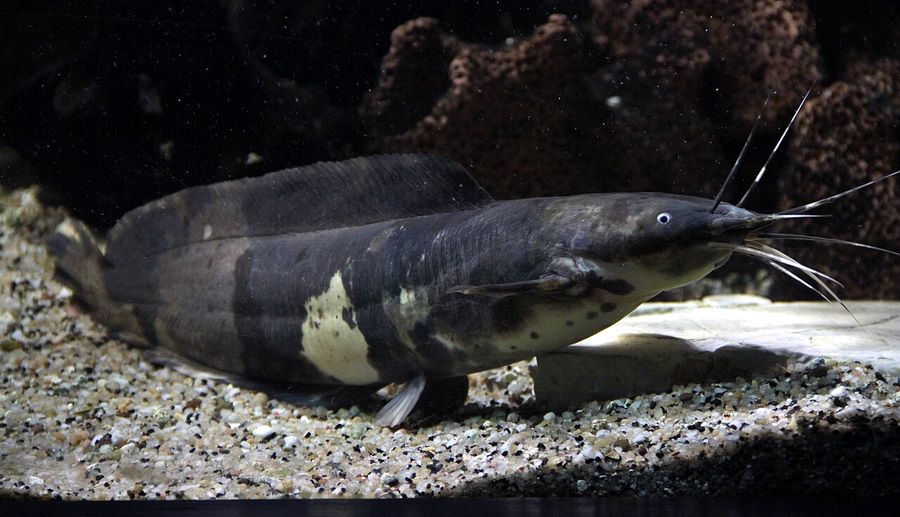
A walking catfish resting on sand, showing the elongated body, the long barbels around the mouth and the pale patch on the flank.
Vassil · Wikimedia Commons · CC0Identified as Clarias batrachus from its source categorisation and reviewed by eye. AquariumHQ publishes no generated imagery of any organism.

What keeping this species involves

Almost impossible to kill and almost impossible to house responsibly. It reaches half a metre, breathes air, climbs out of tanks and eats its tankmates.

Swamps, ditches, rice paddies and stagnant pools, including water too low in oxygen for most fish, which it survives by breathing air.

Identity and names

Common name
Walking catfish
Scientific name
Clarias batrachus
Family
Clariidae
Order
Siluriformes
Class
Actinopterygii
Also sold as
Clarias batrachus, clarias, magur, albino walking catfish

Adult size and growth

30–47 cm (11.8–18.5 in)

Typical lifespan in an aquarium: 8–12 years. Almost every animal sold in a shop is a juvenile, so the tank has to suit the size in the first line rather than the size in the bag.

Shape, which is what the compatibility engine reads instead of length alone: eel-like with a large — a piscivore's mouth. A broad flat mouth on an eel-like body — it is both wide-gaped and slender, which the family default catches and the length rule did not.

Water and tank requirements

A fish approaching half a metre that must reach the surface to breathe and will leave the tank if it can. Floor area and a sealed lid are both requirements.

Temperature (°C)

Walking catfish
20–30

Scale: 0 to 36 °C.

pH (pH)

Walking catfish
6–8

Scale: 4 to 9.5 pH.

Hardness (°dGH)

Walking catfish
3–20

Scale: 0 to 30 °dGH.

The bands AquariumHQ publishes for the walking catfish, each drawn against the full range this catalogue uses for that parameter. A narrow band on a wide scale is a specialist; a wide one is a genuinely tolerant animal. Source: AquariumHQ husbandry position for this record — an editorial range, not a measurement

Why these ranges: A species found in water that would kill most fish, from cool ditches to warm stagnant paddies. The wide band is a documented tolerance and it is not an invitation to test the limits.

Where these figures come from

Habitat class

Rice paddy, ditch and drain

Shallow, still, sun-warmed managed water — agricultural rather than natural, and now the primary habitat of a number of aquarium species.

Enormous daily and annual temperature swing, low oxygen and shallow water. Species from here tolerate far more than a tropical community setting suggests, and several of them do not want to be kept at 26 °C all year.

Conductivity
80–500 µS/cm
Flow
still
Dissolved oxygen
low
Seasonality
strong

These are figures for the KIND of water body, not measurements of this species. They are AquariumHQ’s summary of the general limnology and are given wide because the water is.

TemperatureReasoned on this record
This record states its own reason for this band. See the water section.
pHReasoned on this record
This record states its own reason for this band. See the water section.
General hardnessReasoned on this record
This record states its own reason for this band. See the water section.
RequirementValueNotes
Temperature20–30 °C (68–86 °F)Stability matters more than hitting an exact figure.
pH6–8A stable pH outside the ideal band is usually better than an unstable one inside it.
General hardness3–20 °dGHCheck your supplier's published figure before choosing species.
Minimum volume400 L (106 US gal)A floor, not a recommendation.
Minimum footprint180 cm long × 50 cm deepA fish approaching half a metre that must reach the surface to breathe and will leave the tank if it can. Floor area and a sealed lid are both requirements.
Water flowlowMatch the outflow to this rather than to the filter's rating.
Lid requiredYesThis species jumps.
StructureOpen floor with large caves and a securely weighted lid. Access to the surface is a physiological requirement rather than a preference.

Group size and social behaviour

Aggressive towards its own kind at adult size and predatory towards everything else. A single specimen in a species tank is the realistic arrangement.

Structure
Solitary

Behaviour

  • Uses the stiffened pectoral spines to lever itself forward over damp ground, which is how it moves between pools and how it leaves aquaria.
  • Breathes atmospheric air through a paired arborescent organ above the gills, so it must be able to reach the surface at all times.

Telling males from females

Males have a more pointed genital papilla and are slimmer in condition. Not readable in juveniles.

Feeding

An indiscriminate omnivore that eats fish, invertebrates, plant material and carrion. It is very easily overfed and grows accordingly.

Diet type
Omnivore
Staples
Large sinking pellets, Prawn, Mussel, Earthworm
Avoid
Live feeder fish, Mammalian meat

Breeding

Strategy
Eggs laid in an excavated nest and guarded by the parents
Difficulty
challenging
Parental care
guarding

Farmed at scale across Asia as a food fish. Aquarium spawning is uncommon and the fry are cannibalistic.

Tankmates and compatibility

Assessments are derived from stored traits by the compatibility engine, with the reasoning shown. A verdict is a statement about probability, not a guarantee — individual temperament can override it.

Risk this species poses to common tankmates
TowardsRiskWhat it means
Small fishnear-certainAnything that fits in the mouth is at risk once this species reaches adult size.
Adult dwarf shrimpnear-certainCover reduces losses but rarely prevents them where the risk is high.
Shrimpletsnear-certainDetermines whether a shrimp colony can grow rather than merely persist.
SnailsmoderateApplies to snails you wanted as well as snails you did not.
Long or trailing finsnoneFin damage is an entry point for secondary infection.
PlantsuprootsTough species such as Anubias and Java fern survive most grazers.

Any pair in the catalogue can be assessed with the compatibility checker.

Welfare considerations

Points where the way this species is commonly sold or kept differs from what it actually needs.

  • The albino form is the one usually sold and is the same animal. Its adult size is not smaller and its temperament is not milder.
  • Established and invasive in Florida following escapes from aquaculture facilities in the 1960s, and it is restricted or prohibited in a number of jurisdictions as a result.

Problems to watch for

Most problems in a tank containing this species are general rather than species-specific. Start with the troubleshooting index and work from the observation rather than from a guess at the cause.

What AquariumHQ does not yet hold

Species-level disease susceptibility is modelled in the graph and is not yet populated. Health pages will not be published until each condition has veterinary sourcing, because health content written without evidence is the most harmful thing this product could publish. The gap is recorded in the coverage report.

Where it comes from

Native range
South and South-East Asia natively; introduced and invasive in Florida and elsewhere
Habitat
Swamps, ditches, rice paddies and stagnant pools, including water too low in oxygen for most fish, which it survives by breathing air.

What the checklists say

40 distribution statements retrieved from GBIF checklists. Establishment means is reproduced from the source where it states one, and left unstated where it does not — a record of presence is not a record of origin.

StatusPlacesWhat this means
Introduced30A checklist states the species arrived here with human help. That is not a statement that it is established, harmful or illegal.
Recorded as present, establishment means not stated10The source records the species as present and does not say whether it is native or introduced. AquariumHQ does not fill that in.

No checklist AquariumHQ holds positively calls this species native anywhere, so the native range above rests on AquariumHQ’s own reading of the literature rather than on a cited checklist.

Evidence

Every stored value with the kind of support behind it and where to check it. Evidence type and confidence are separate axes: an editorial position held confidently and a measurement held tentatively are different things.

ClaimValueEvidence typeConfidenceSource
scientific nameClarias batrachusObserved / measuredhigh confidenceCatalogue of Life; GBIF — Global Biodiversity Information Facility
native rangeSouth and South-East Asia natively; introduced and invasive in Florida and elsewhereObserved / measuredmoderate confidenceGBIF — Global Biodiversity Information Facility
adult size30–47 cmAquarium-literature consensusmoderate confidenceAquariumHQ husbandry synthesis
lifespan8–12 yearsAquarium-literature consensusmoderate confidenceAquariumHQ husbandry synthesis
temperature20–30 °CAquarium-literature consensusmoderate confidenceAquariumHQ husbandry synthesis
ph6–8 pHAquarium-literature consensusmoderate confidenceAquariumHQ husbandry synthesis
general hardness3–20 °dGHAquarium-literature consensusmoderate confidenceAquariumHQ husbandry synthesis
minimum tank volume≥ 400 LAquariumHQ editorial positionmoderate confidenceAquariumHQ husbandry synthesis
minimum tank length≥ 180 cmAquariumHQ editorial positionmoderate confidenceAquariumHQ husbandry synthesis

Last reviewed 2026-08-10. Values labelled as an aquarium-literature consensus are AquariumHQ editorial positions rather than measurements — see how evidence is handled.

Why we say this

What each figure on this page rests on, and how far that is from being independently established.

Every figure on this page has a provenance. Open any claim to see what AquariumHQ holds for it, which sources say what, and what a claim of that kind actually needs. Different claims need different evidence: an accepted scientific name is settled by one authority, while a legal restriction needs a current primary instrument. A single source is often the right answer rather than a thin one.

scientific nameAquariumHQ's own position, externally checkableBased on a verified authoritative source.

AquariumHQ's own position on a claim an external source could support.

What this kind of claim needs: accepted scientific name and classification — 1 authoritative source in an appropriate context. Checked against gbif on 2026-08-29. One authoritative backbone is what this class requires.

What would improve this: Go and read a source. This is reachable and has not been reached.

native rangeAquariumHQ's own position, externally checkableBased on a verified authoritative source.

AquariumHQ's own position on a claim an external source could support.

What this kind of claim needs: where the species occurs — 1 authoritative source in an appropriate context. 40 distribution statements held from GBIF checklists — introduced in 30 country. Establishment means is reproduced from the source, never inferred from occurrence.

What would improve this: Go and read a source. This is reachable and has not been reached.

adult sizeOne sourceAquariumHQ's own position, derived from evidenced inputs.1 citation, 1 independent origin

A single source: usgs-nas.

  • 61 cm — USGS Nonindigenous Aquatic Species database · Maximum recorded · Observed in the wild · checked 2026-08-29

What this kind of claim needs: size a well-kept specimen reaches — no external source is required, provided AquariumHQ shows its reasoning. A documented maximum is held and the catalogue's typical adult range is stated separately, with the relationship between them recorded rather than collapsed. A well-grown adult may be substantially larger than the typical figure — 61 cm TL against a typical 30–47 cm. Large enough to change what tank is appropriate.

What would improve this: Corroborate against a second, independent source.

lifespanAquariumHQ's own position, externally checkableAquariumHQ's own position, derived from evidenced inputs.

AquariumHQ's own position on a claim an external source could support.

What this kind of claim needs: what aquariumhq advises for keeping — no external source is required, provided AquariumHQ shows its reasoning. No external source is required for this class. AquariumHQ's position stands on its stated reasoning.

What would improve this: Go and read a source. This is reachable and has not been reached.

temperatureAquariumHQ's own position, externally checkableAquariumHQ's own position, derived from evidenced inputs.

AquariumHQ's own position on a claim an external source could support.

What this kind of claim needs: what aquariumhq advises for keeping — no external source is required, provided AquariumHQ shows its reasoning. No external source is required for this class. AquariumHQ's position stands on its stated reasoning.

What would improve this: Go and read a source. This is reachable and has not been reached.

phAquariumHQ's own position, externally checkableAquariumHQ's own position, derived from evidenced inputs.

AquariumHQ's own position on a claim an external source could support.

What this kind of claim needs: what aquariumhq advises for keeping — no external source is required, provided AquariumHQ shows its reasoning. No external source is required for this class. AquariumHQ's position stands on its stated reasoning.

What would improve this: Go and read a source. This is reachable and has not been reached.

general hardnessAquariumHQ's own position, externally checkableAquariumHQ's own position, derived from evidenced inputs.

AquariumHQ's own position on a claim an external source could support.

What this kind of claim needs: what aquariumhq advises for keeping — no external source is required, provided AquariumHQ shows its reasoning. No external source is required for this class. AquariumHQ's position stands on its stated reasoning.

What would improve this: Go and read a source. This is reachable and has not been reached.

minimum tank volumeAquariumHQ's judgement — no authority publishes thisAquariumHQ's own position, derived from evidenced inputs.

No external authority publishes this. The rationale carries the reasoning.

What this kind of claim needs: minimum tank size — no external source is required, provided AquariumHQ shows its reasoning. No authority publishes this. AquariumHQ derives it, and the derivation is recorded with its inputs and assumptions.

What would improve this: Keep the rationale current. There is no source to find.

minimum tank lengthAquariumHQ's judgement — no authority publishes thisAquariumHQ's own position, derived from evidenced inputs.

No external authority publishes this. The rationale carries the reasoning.

What this kind of claim needs: minimum tank size — no external source is required, provided AquariumHQ shows its reasoning. No authority publishes this. AquariumHQ derives it, and the derivation is recorded with its inputs and assumptions.

What would improve this: Keep the rationale current. There is no source to find.

Guides relevant to this species

Chosen from this record's own traits rather than listed on every page.